Twenty-five horses you have never met
Nobody brings a horse to the Mongol Derby. You are handed a semi-wild one every forty kilometres, twenty-five times, and the clock punishes you for its heart rate.
Some links in this post are affiliate links — I may earn a commission at no cost to you.
I found the Mongol Derby the way I find most things, which is late and by accident. The distance was not what caught me. It was one sentence about the horses: you do not bring one.
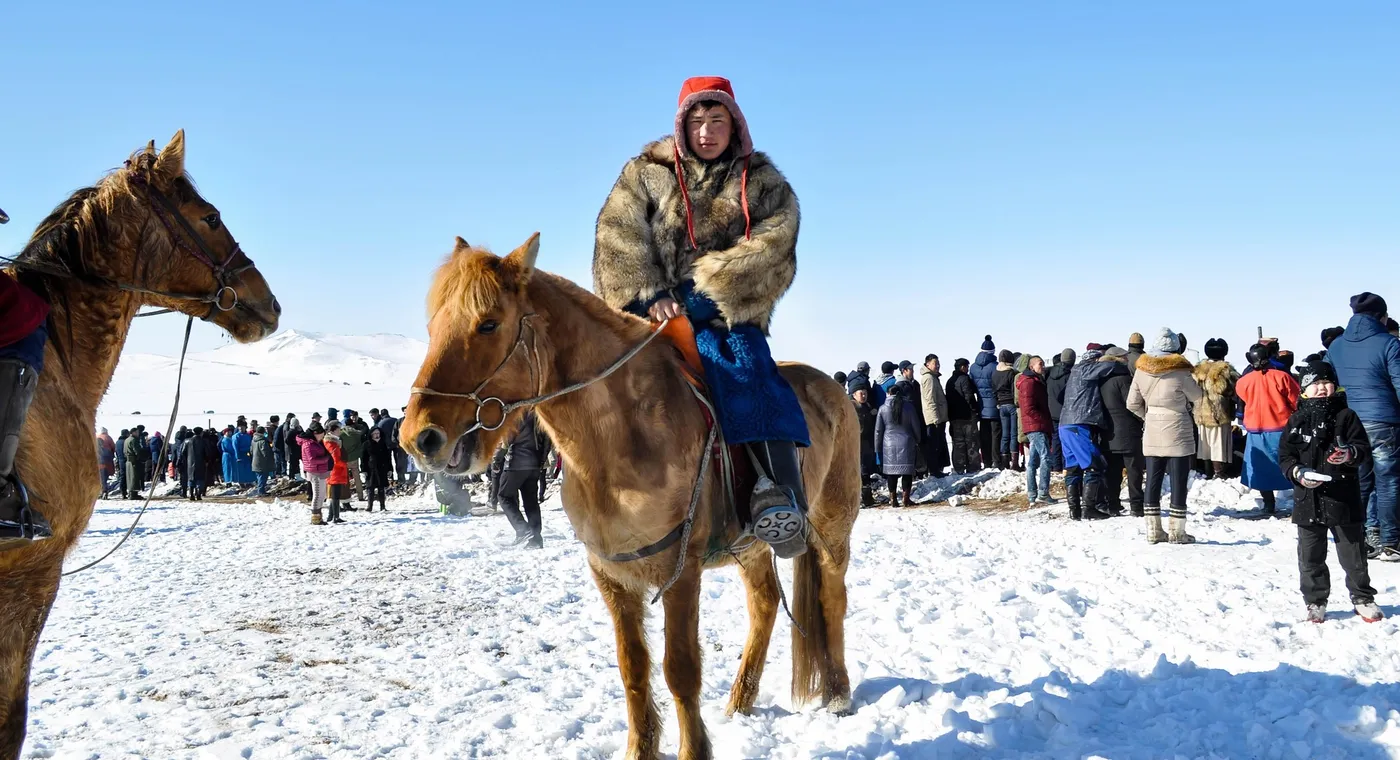
A thousand kilometres of Mongolian steppe in ten days, and every forty kilometres you stop at a horse station, get off, and are handed a different animal you have never sat on. Twenty-five to twenty-seven of them over the race, semi-wild, belonging to the herding family who runs that station.
Consider what that removes. Almost everything a competent rider knows is knowledge about one particular horse. This one spooks at motorbikes. This one leans on your left rein all day and you have learned to stop asking. That knowledge is the relationship, and it takes weeks. On the Derby you get it twenty-five times from a standing start, and you get maybe four minutes of it before you have to decide how hard you are willing to push.
I have never sat on a Mongolian horse. From the outside this looks less like a race than an examination in reading strangers, held at a gallop, for ten days.
That is true of the ordinary kind of Mongolian riding holiday as well, the sort with no clock and no stations. I have never booked one, and I still end up on the page for one most times I go looking for anything about these horses.
The relay is eight hundred years old
The course copies a postal system Genghis Khan established in 1224. His messengers rode between relay stations called morin urtuu, sometimes more than a hundred miles between one and the next, and mail crossed the empire at something like three hundred miles a day.
The part I keep returning to is how it ended. The system ran until 1949, when the Soviet Union shut it down. That is seven hundred and twenty-five years. It outlived the empire that built it by centuries, and then it stopped inside the lifetime of people who are still alive to be asked about it.
The rule that does the work
Here is where the race got genuinely interesting to me, because the obvious objection has an answer built into the rules.
At every station a vet takes the horse’s heart rate. National Geographic puts the threshold at 64 beats per minute within thirty minutes of stopping. If the rate is not back down, the rider takes a two-hour penalty. The organiser’s own phrasing for it is that riders are “penalised for over-riding”.
Read that again as a piece of design. The horse cannot complain, cannot withdraw, and does not care who wins. So the rule does not ask the rider to be kind. It makes the clock the enforcement: ride this animal harder than it can recover from and you lose two hours, which is more than you gained. A rider chasing a win and a rider protecting a horse are pushed toward the same behaviour, and neither of them has to be a better person for it to work.
There is a weight rule with the same flavour. A rider is weighed at 85 kilograms maximum, and that figure includes the riding clothes, the empty pack, the empty water container and the Mongolian saddle and bridle. Another five kilograms is allowed in the packs after the weigh-in. Five kilos for ten days. Whatever you think you need, you are carrying less than that.
Nineteen, and seventy
In 2013 Lara Prior-Palmer won it. She was nineteen and British, and Wikipedia records her as the first woman to win the Mongol Derby and the youngest person ever to complete it. She rode it in seven days. Her book about it, Rough Magic, is on my list rather than behind me.
In 2019 Bob Long won it. He was seventy, from Boise, Idaho, and he finished in seven and a half days. He was fifteen years older than the next oldest rider in a field of forty-four from twelve countries. InsideHook is precise about the record he holds: oldest rider ever to finish, rather than the oldest to win. The youngest competitor that year was nineteen.
Put those two winners next to each other and the race stops looking like an athletic event. Nineteen and seventy is a fifty-one year spread on the same course, and whatever separates a finisher from the half of the field that does not finish, it is not the thing that peaks in your twenties.
What it costs
It is common for only half the riders to finish in a given year. Asked what goes wrong, the organisers listed it to National Geographic as “broken bones, torn ligaments, a broken pelvis, a punctured lung, broken collarbones, lots of ribs…and once a neck”. The trailing “and once a neck” is doing a lot of work in that sentence.
A horse died on the race in 2016. It was ridden by Tatiana Mountbatten and it went down between the twenty-third and twenty-fourth stations. In Equnews’s report, a post mortem by Dr Jeremy Hubert found “a massive diaphragmatic rupture”, and the organiser stated that there was no evidence anything the rider did while the horse was under saddle caused it.
The race also has organised opposition. I did not expect that, and probably should have. The Long Riders’ Guild ran a petition against it signed across twenty-six countries, and among the signatories are veterinarians. One of them says plainly that this is “not ‘endurance’ - it is torture to horses”. That petition dates from 2008, the year before the first Derby ran.
Twenty-five families
The thing I did not see coming is who the race actually belongs to.
The stations are not infrastructure. Each one is a herding family, on their own land, lending their own working animals to a stranger who will ride one of them forty kilometres and hand it back. Riders live with those families through the ten days. Take the families out and there is no race, no relay and no course, just a very long walk.
Every one of those twenty-five stations is also, underneath the race, just a yard: horses fed, watered and mucked out on the same morning whether or not anybody is timing them that week. That is the one part of the whole event I do have direct experience of, at a much smaller scale, and it needs nothing more exotic than a fork.
Affiliate link — I may earn a commission
Manure fork, plastic tine
So the winner is the rider who can meet twenty-five unfamiliar horses and be wrong about them the fewest times. I would like to know what the herding families make of that. Being best in the world at reading strangers quickly is an odd way to win a horse race, and I have not stopped turning it over since.