The horses that were too white
AQHA prints 'undesirable trait' on the certificate of a horse with too much white. In 1962, sixteen people in a Texas café started a registry for them.
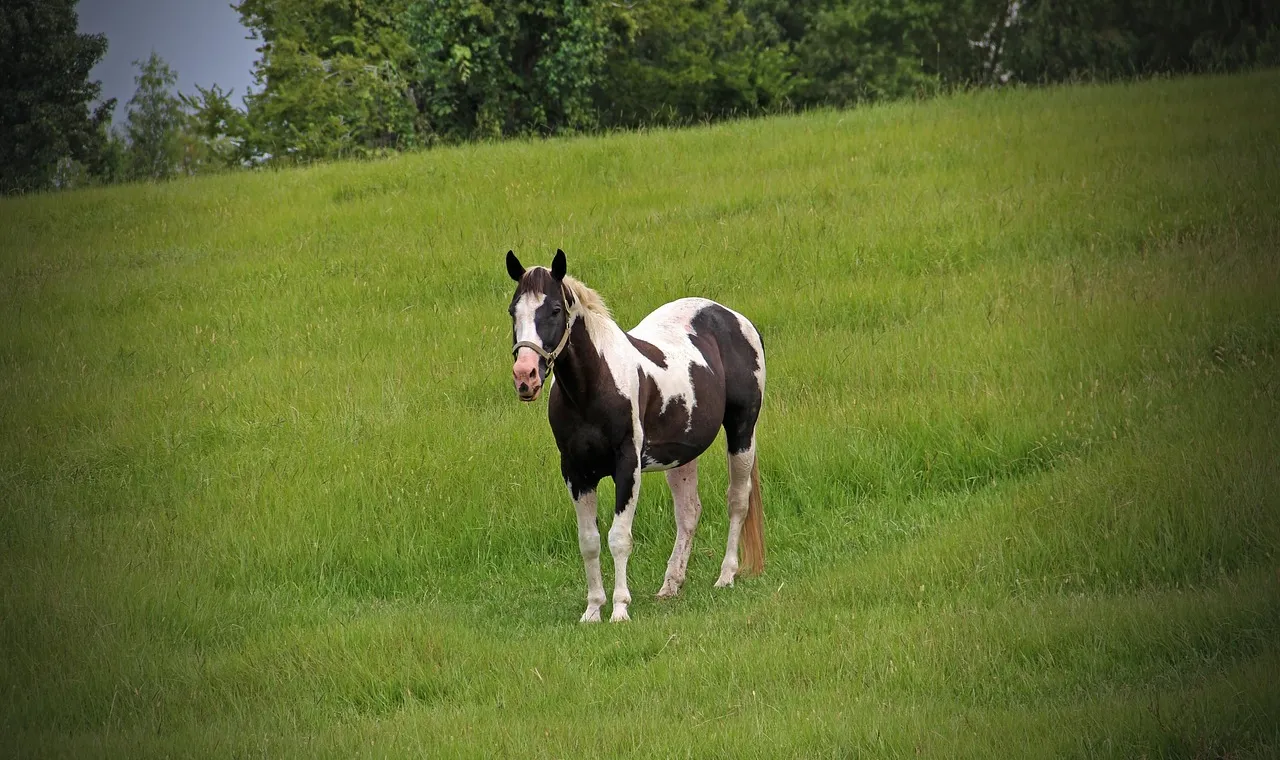
The American Quarter Horse is a solid-coloured breed, and occasionally two registered solid parents produce a foal covered in white patches. Those foals used to be called crop-outs.
What happened next is one of the better stories in this sport, and it starts with a rule written to an almost surgical level of precision.
Where the line runs
AQHA’s registration rules define acceptable white by anatomical landmarks, not by area or percentage. The proscribed lines are these.
On the front leg, a line parallel with the ground drawn halfway between the point of the elbow and the protrusion at the back of the knee. The rule names both in Latin, in case anybody wanted to argue: the olecranon tuberosity and the accessory carpal bone.
On the hind leg, a line at the centre of the gaskin, defined as the point equidistant between the stifle joint and the centre of the hock, with the reference points given as the medial condyle and the medial malleolus of the tibia.
Around the neck, a line immediately behind the poll and through the midpoint of the throat latch. Along the belly, a band two inches either side of the midline, from between the front legs back to and including the sheath or udder.
Beyond that, one exception: a single white area small enough to be completely covered by a disc one inch across.
There is a final clause I keep re-reading. For determining these limits, a horse may be inspected from any angle or distance, and the person conducting the inspection may be standing, crouching, or in any other position.
Somebody, once, argued about the angle.
What the certificate says
A horse over the line can still be registered today, provided its parentage is confirmed by DNA typing of the foal, the sire and the dam.
But the certificate then carries a sentence, printed on the document, in the association’s own words: this horse has white markings designated under AQHA rules as an undesirable trait and uncharacteristic of the breed.
The rules say the same thing in the paragraph above it. Such markings are uncharacteristic of the breed and are considered to be undesirable traits.
A horse carrying that notation cannot be shown in halter, the class judged purely on conformation.
Sixteen people in a café
On 16 February 1962, a group of sixteen met at a café in Gainesville, Texas, and formed the American Paint Stock Horse Association. The American Paint Horse Association credits Rebecca Tyler Lockhart with inspiring it, to promote and preserve colourful, stock-type Paint horses.
Registration number 1 was Bandit’s Pinto, a black tobiano stallion foaled in 1959.
By the end of that first year there were 150 members and 250 registered horses. Around the same time, in West Texas, the American Paint Quarter Horse Association started up with the same goal. In 1965 the two merged into the American Paint Horse Association.
The thing worth sitting with
These are, in large part, the same horses. A crop-out foal has registered Quarter Horse parents, Quarter Horse conformation, and Quarter Horse ability. Every trait the breed standard describes is present. The only disqualifying feature is where the white stops.
So one registry wrote a rule declaring that pattern undesirable and uncharacteristic, and a handful of people who liked those horses built a second registry where the same pattern is the requirement rather than the flaw.
Both associations are large, established and run serious competition today, and Paint horses show in the same disciplines under substantially similar rules. The split was never about whether the horse could work.
I find the surgical precision of the white rule funnier and stranger the longer I look at it. A registry defined the boundary of an acceptable horse using the medial malleolus of the tibia, and somewhere in Texas a group of people read that and decided to start again.